Which is better: air-cooled or water-cooled induction sealing?
Neither cooling method is automatically better for every project. Select the equipment from the required duty, environment, utilities, maintenance boundary and proven pack performance.
Cooling controls the equipment temperature, not the liner chemistry.
Air-cooled induction sealers use fans and airflow to remove heat from the power and sealing system, while water-cooled equipment uses a liquid circuit as part of its thermal management. The supplied Lancing range is air cooled, which can simplify the installation because an external water circuit is not required. The correct choice still depends on the verified machine duty, ambient conditions and maintenance plan.
Cooling architecture does not make an incompatible liner seal to a container and does not replace sample testing. Power, exposure time, head geometry, cap torque, liner construction and container mouth condition remain the primary pack variables.
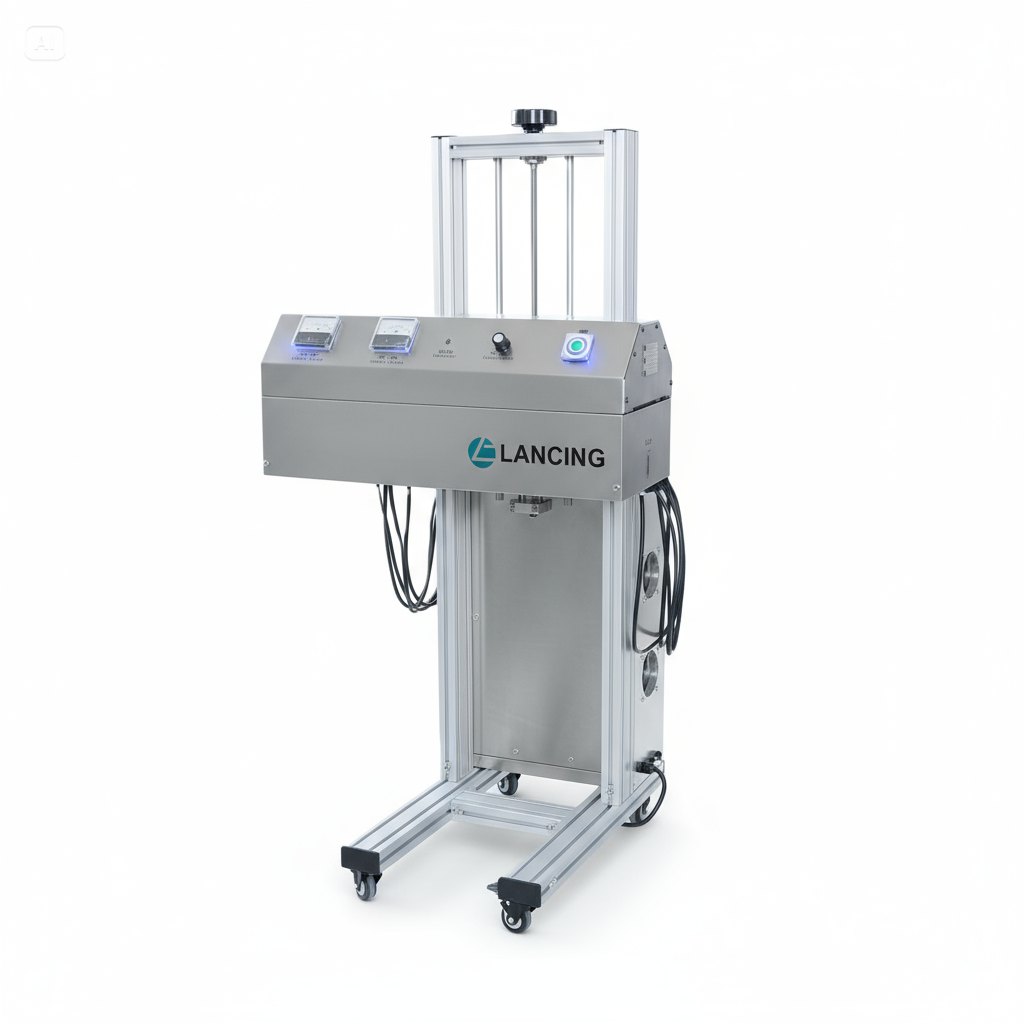
Compare the complete operating boundary.
| Decision area | Air-cooled route | Water-cooled route |
|---|---|---|
| Site utilities | Requires clear airflow, ventilation and the specified electrical supply. | Requires the specified electrical supply plus a suitable water or chiller circuit and responsibility for that circuit. |
| Maintenance focus | Fans, filters, vents, ambient dust and unobstructed airflow. | Water quality, flow, leaks, hoses, heat exchanger or chiller condition as applicable. |
| Environment | Confirm ambient temperature, enclosure airflow and access around the machine. | Confirm ambient conditions and where the cooling circuit can be installed and monitored. |
| Pack performance | Must be proved with the actual cap, liner, container, head and intended operating window; cooling type alone does not establish seal quality. | |
Information to provide before choosing a cooling method
- Normal and peak containers per minute, shift duration and expected stop/start pattern.
- Cap diameters, liner constructions and the format that produces the highest sealing load.
- Ambient temperature, dust, washdown expectations and available clearance around vents or cooling equipment.
- Electrical supply and, if relevant, water or chiller availability and ownership.
- Maintenance capability, planned inspection routine and access for service.
- Required controls, alarms and response to over-temperature or cooling faults.
Questions about air-cooled and water-cooled induction sealers
Does water cooling create a stronger foil seal?
No. Seal strength is established by the liner and container compatibility plus the controlled energy delivered during the sealing window. Cooling helps the machine operate within its thermal design; it does not change the fundamental requirement for correct cap pressure, head position and sample validation.
Can an air-cooled unit run continuously?
It can only be described as suitable for continuous duty when the specific machine is rated and proven for the stated production conditions. Provide the expected shift pattern, speed, cap range and ambient conditions. Do not infer duty from the cooling label alone.
Which site utilities does each cooling method need?
An air-cooled machine normally needs the quoted electrical supply and unobstructed ventilation, while a water-cooled design also needs the specified cooling circuit and responsibility for its flow and condition. The exact requirement is model-specific and must be confirmed in the quotation and site-preparation documents.
Which cooling system suits a warm production area?
The answer depends on the verified ambient limit, heat load and ventilation or cooling infrastructure. A warm area can reduce the margin available to an air-cooled system, but a water-cooled route also needs a suitable circuit and maintenance. Record the real seasonal conditions rather than using a general room-temperature assumption.
Can the cooling method be changed after purchase?
Do not assume that an installed induction sealer can be converted from one cooling architecture to another. Cooling is part of the machine design, controls and enclosure. Select it during specification or confirm a manufacturer-approved conversion before relying on a future change.
Related induction sealing guidance
Define the real duty before comparing cooling methods.
Send Lancing the pack range, shift pattern, speed and site conditions for an evidence-based machine discussion.