Flat versus tunnel induction sealing heads
Choose the head style from the closure geometry, foil position, format range and production conditions, then prove the choice with representative samples.
Head type affects how the induction field reaches the foil liner.
A flat induction sealing head is normally considered when several cap sizes or relatively standard closures need flexible coverage, while a tunnel-style or more shaped head may be considered when the closure geometry, line speed or foil position needs a more controlled field relationship. The right choice is not made from the cap diameter alone. It depends on cap profile, liner depth, bottle presentation, head clearance, line speed, pack stability and the number of formats that must run.
For a Lancing project, the safest route is to group the intended caps and liners, identify the hardest-to-seal pack, then confirm the head route with sample testing. One broad-range head may be practical for a narrow SKU family, while a mixed-format contract-packing line may need tighter grouping or a second setup.
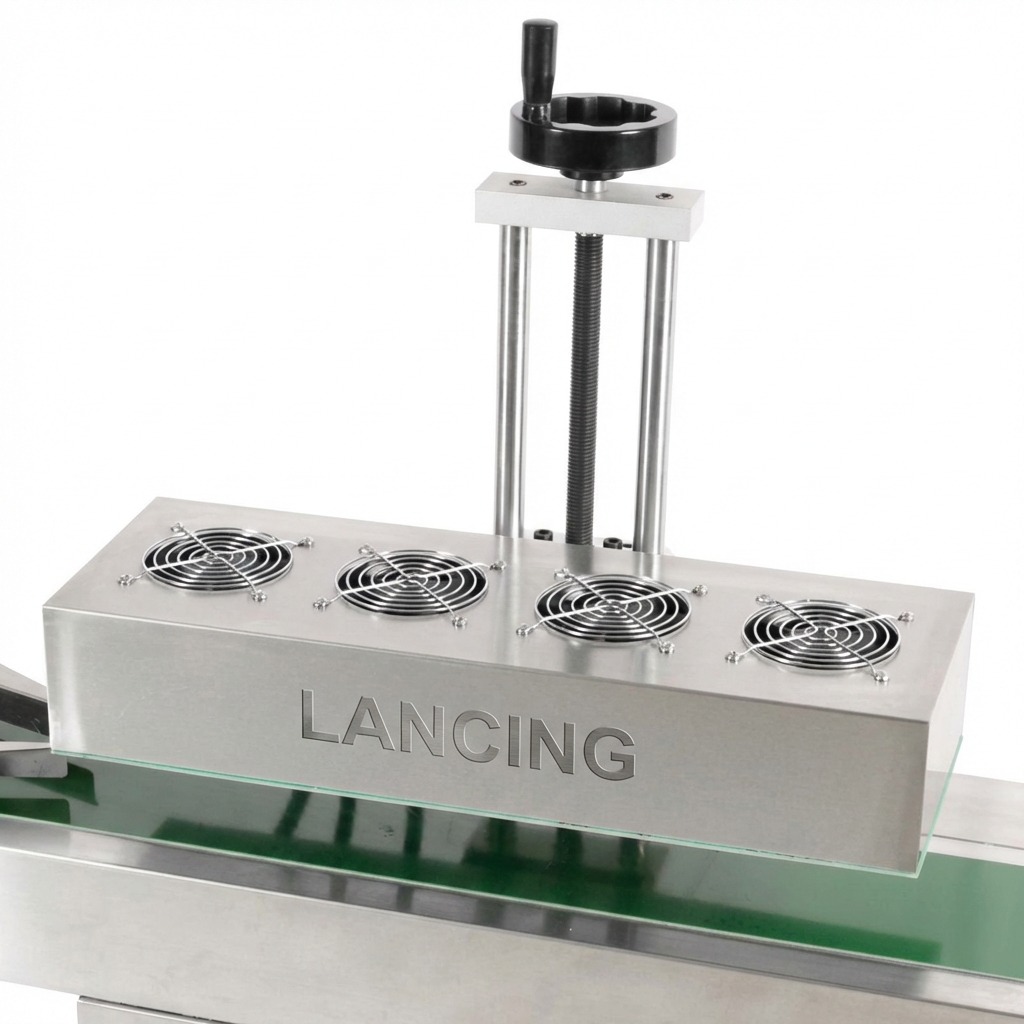
Use head style as a sealing-window decision, not a brochure choice.
The table below keeps the comparison qualitative because final performance depends on the actual cap, liner, container and conveyor conditions.
| Head route | Where it can help | What still needs proving |
|---|---|---|
| Flat sealing head | Useful where the closure top is relatively accessible and several similar cap sizes need a flexible starting point. | Check edge bond, centre bond, working distance, bottle centring and whether the largest/smallest formats can share a stable setting. |
| Tunnel or shaped head | Can be considered where the closure profile, foil position or presentation benefits from a field around a more defined path. | Confirm the pack can pass consistently, that changeovers remain practical and that unusual caps do not create clearance or heating problems. |
| Dedicated or second head | Useful when one compromise head would create repeated setup risk across very different cap groups. | Justify it with trial evidence, changeover frequency, output requirement and the cost of rejected packs or downtime. |
Questions to answer before choosing the head
- What are the smallest and largest cap outside diameters?
- Is the top of the cap flat, raised, ribbed, stepped, child-resistant, spouted or dispensing-style?
- How far below the cap top is the foil liner?
- Does the container stay centred under the head at the intended speed?
- Will the same line run glass, PET, HDPE or PP containers with different liner constructions?
- How many format groups need repeatable changeover records?
Buyer questions about flat and tunnel induction sealing heads
Which induction sealing head is best?
The best induction sealing head is the one that gives a repeatable seal on the actual cap, liner and container at the required line conditions. A flat head may suit flexible standard work; a tunnel or shaped head may be considered for more defined geometry. Neither should be selected without representative samples.
Can a flat head run every cap size?
No single head should be assumed to run every cap size or geometry. A nominal range can be useful, but a large closure, small closure, recessed foil or unusual top profile can require different settings or a different head route. Each format group should have a recorded sealing window.
Does sealing-head choice affect production speed?
Yes, because head choice affects the field relationship and the dwell time needed under the induction field. The practical speed is confirmed by sample testing with the intended conveyor speed, bottle spacing, cap torque, liner construction and cooling interval.
What samples are needed for a head-selection trial?
Send the hardest and easiest packs in the range: smallest cap, largest cap, tallest container, widest mouth, unusual closure and any different liner construction. Include cap and liner supplier details where available so the trial checks the real packaging system, not only the machine.
Need help choosing a sealing head?
Send cap samples, liner information, container photos and target line speed so Lancing can identify the right head-selection path.