Can induction sealers seal wide-mouth jars and tubs?
Yes, when the wide-mouth closure, liner, container rim and sealing head are compatible and the complete circumference is proven under representative production conditions.
Wide-mouth packs need even energy and pressure around a larger rim.
Induction sealers can seal wide-mouth jars and tubs when the head can distribute energy across the foil, the cap holds the liner evenly and the container rim is flat, clean and compatible with the heat-seal layer. A large nominal diameter does not by itself prove that the complete edge will bond. The largest pack should be trialled as a boundary format.
Check the seal around the full circumference after a consistent cooling interval. A peel result from one convenient point can miss a weak edge elsewhere, particularly where the container mouth, cap pressure or field distribution varies.
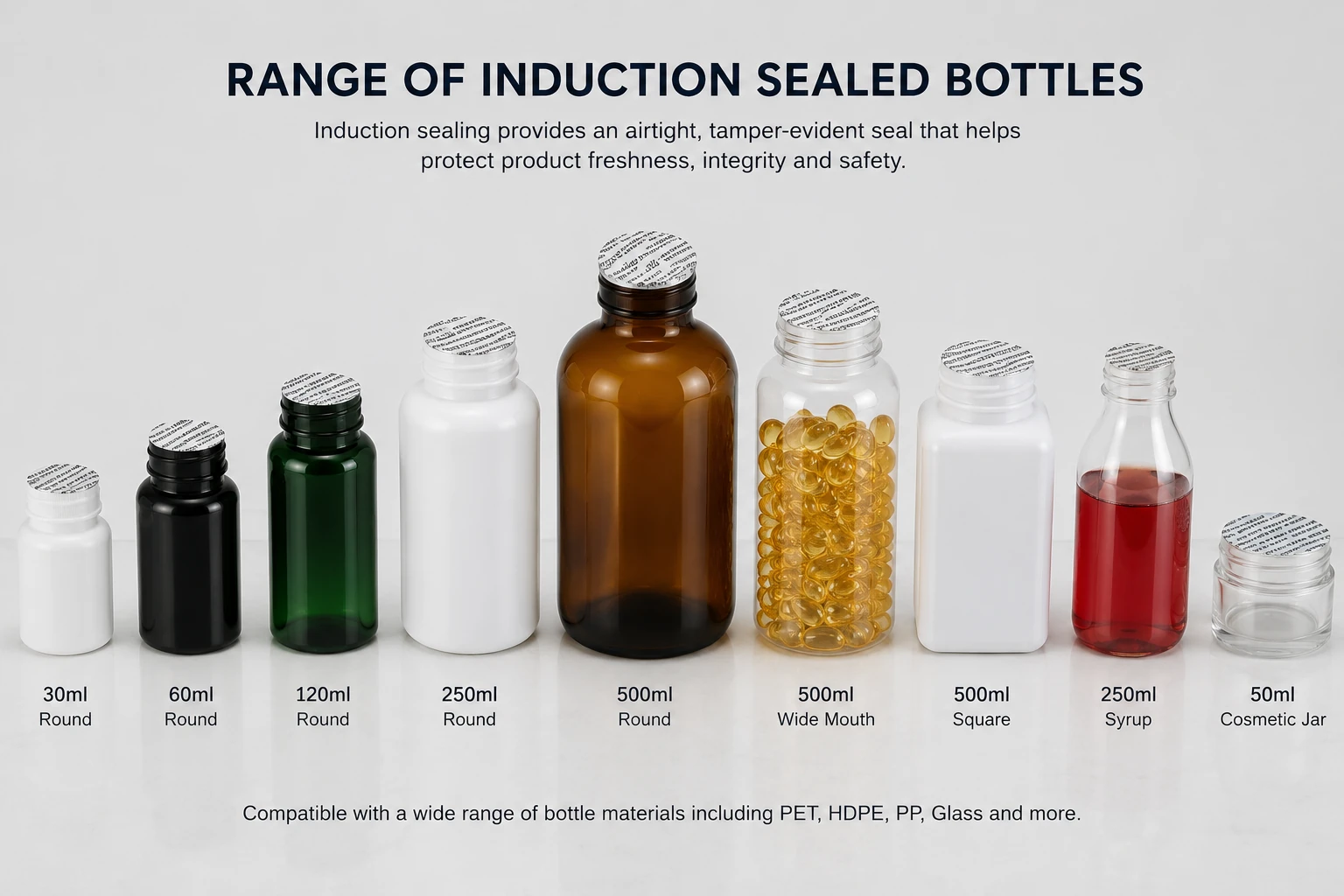
Inspect the complete rim and closure system.
| Variable | Why it matters |
|---|---|
| Foil diameter and position | The head must deliver an even field across the required area and at the actual foil depth. |
| Rim width and flatness | Warp, moulding variation or an interrupted land can create local gaps in the bond. |
| Cap pressure | The closure must hold the liner evenly against the mouth without distorting the pack. |
| Container rigidity | Flexible tubs can deform during capping, handling or cooling, changing contact at the rim. |
| Product cleanliness | Powder, oil, cream or liquid on a broad rim can interrupt the seal over a larger area. |
| Acceptance method | Use circumferential inspection, controlled peel points and a relevant leak method rather than one visual check. |
How to prove a wide-mouth sealing window
- Supply the largest and smallest wide-mouth packs plus any closure with a different profile.
- Confirm the liner seal layer and the container resin or glass treatment.
- Apply caps using the intended method and verify that the liner is held evenly.
- Trial several controlled power and speed conditions rather than only one setting.
- Allow the same cooling interval before every peel or leak check.
- Inspect the centre and the full edge, then retain accepted and rejected samples with the recorded setup.
Questions about wide-mouth induction sealing
Does a wider seal always need more power?
Not as a simple rule. Foil area, head efficiency, working distance, liner construction, speed and container conditions all affect the energy required. A wide mouth may need a different head or operating window, but power should be established by controlled trials rather than increased automatically.
Can one head seal small caps and wide-mouth closures?
Possibly, if the head is designed for the complete range and each format has a proven setting. A very broad range can create compromises in field geometry or changeover control. Use the head-selection guide to decide whether a second head should be trialled.
Why can the centre seal while the edge remains weak?
The field, cap pressure or rim contact may be more effective in one part of the closure than another. Check head alignment, working gap, cap and liner position, rim flatness and product contamination. Do not approve the pack from a central appearance alone.
How should edge bond and leak performance be checked?
Use a repeatable inspection pattern around the circumference and a leak method relevant to the product and distribution risk. Record where a peel begins, the cooling interval and any local weak area. The seal-validation guide explains how to build comparable evidence.
Can flexible tubs be induction sealed?
They may be suitable when the container, rim, closure and liner are designed for induction sealing and remain stable under cap pressure and heat. Flexible walls or rims can distort and reduce contact, so physical samples and the intended capping method are essential.
Send the widest closure and the most flexible container.
Lancing can use the boundary packs to identify the head and trial conditions that need to be proven.